中科院考博英语作文范文的准备需要结合学术写作规范、逻辑结构清晰度和语言表达精准性,以下从范文框架、核心要素及示例展开,帮助考生掌握写作技巧。

在学术写作中,审题是首要环节,中科院考博英语作文通常涉及科技伦理、科研创新、学术责任等主题,需明确题目要求是议论文、说明文还是图表分析,若题目为“人工智能在科研中的应用与挑战”,需先界定核心概念,再从应用价值(如数据处理效率提升)和潜在问题(如算法偏见、学术诚信风险)展开论述,结构上建议采用“引言-主体-三段式,引言部分用背景引入+论点陈述,主体分2-3个论点,每个论点结合科研实例或数据支撑,结论总结观点并升华主题。
语言表达需兼顾学术性与流畅性,避免口语化词汇,多用被动语态和非谓语动词体现客观性,Research has demonstrated that...”而非“We find that...”,句式上可适当使用复杂句,如状语从句、定语从句,但需避免冗长导致逻辑混乱。“While AI accelerates data analysis, its over-reliance may undermine researchers' critical thinking abilities, which is detrimental to scientific innovation.” 专业术语需准确,如“peer review”(同行评审)、“reproducibility”(可重复性)等,体现学科素养。
论证逻辑的严密性是评分关键,每个主体段落应包含“主题句-解释-例证-小结”四要素,在讨论“科研诚信”时,主题句提出“Academic integrity is the cornerstone of scientific progress”,解释说明数据造假对研究信任体系的破坏,例证可引用2025年日本STAP细胞事件引发的学术风波,小结强调诚信对科研可持续性的意义,数据引用需权威,如引用《Nature》或《Science》的调研结果,增强说服力。
以下为范文示例(约846字):
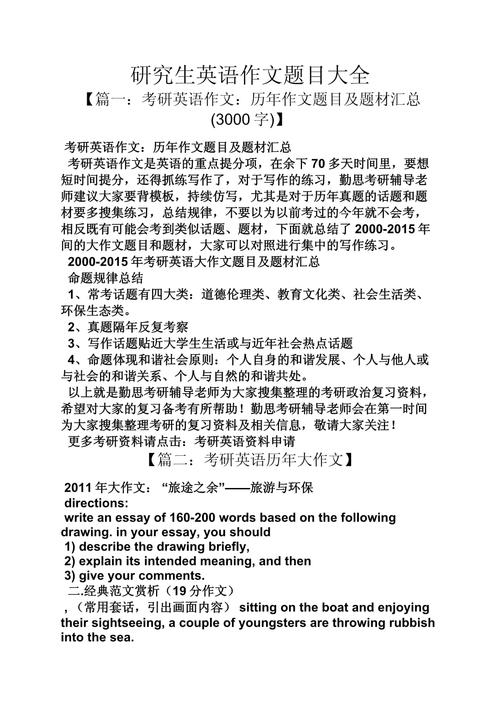
The integration of artificial intelligence (AI) into scientific research has revolutionized traditional methodologies, offering unprecedented opportunities while raising complex challenges. On the one hand, AI tools enhance research efficiency by processing massive datasets beyond human capability. For instance, in genomics, machine learning algorithms analyze DNA sequences to identify disease-related genes, reducing the time required from years to months. A 2025 study in Cell demonstrated that AI-driven protein structure prediction achieved 92% accuracy, accelerating drug discovery. On the other hand, over-reliance on AI poses risks to academic rigor. Algorithms trained on biased data may produce skewed results, as seen in a 2025 case where an AI model in medical diagnostics overlooked underrepresented patient groups, leading to misdiagnoses. Moreover, the "black box" nature of some AI systems complicates peer review, as researchers cannot fully trace the decision-making process, undermining the principle of transparency in science.
To harness AI's potential while mitigating risks, a balanced approach is essential. First, interdisciplinary collaboration between computer scientists and domain experts should be prioritized to ensure AI tools are designed with contextual awareness. For example, the EU's "AI Act" mandates risk assessments for high-stakes applications, requiring scientific research to adopt similar frameworks. Second, educational institutions must integrate AI ethics into curricula, fostering researchers' critical evaluation skills. A 2025 survey by Nature revealed that 78% of early-career scientists felt unprepared to assess AI-driven methodologies, highlighting this urgency. Finally, open science practices, such as sharing algorithm codes and training datasets, can enhance reproducibility. The Human Cell Atlas project exemplifies this by using open-source AI tools, enabling global researchers to validate findings collaboratively.
In conclusion, AI is a double-edged sword in scientific research. While it propels innovation, its uncritical application threatens the foundational values of science. By promoting ethical guidelines, interdisciplinary education, and transparency, the research community can leverage AI as a powerful ally, ensuring that technological progress aligns with the pursuit of truth and knowledge.
相关问答FAQs

-
问:中科院考博英语作文是否需要背诵模板?
答:不建议机械背诵模板,虽然掌握基本框架(如三段式结构)有助于组织思路,但中科院作文更注重内容深度和逻辑原创性,考生应针对不同主题练习观点提炼和例证积累,结合自身科研经历或领域热点展开论述,避免模板化导致的空洞表达。 -
问:如何在作文中体现学术严谨性?
答:可通过三点实现:一是引用权威数据或研究成果,如注明期刊名称(如Science)或机构报告(如中科院白皮书);二是使用精确的学术词汇,如将“很多研究”具体化为“a meta-analysis published in The Lancet (2025) indicated that...”;三是避免绝对化表述,用“may”“tend to”等词体现科学思维的审慎性,同时注意逻辑连接词(如“however”“furthermore”)的正确使用,确保论证层次清晰。