考研复试中的英语口语环节是很多考生关注的重点,常见问题通常围绕个人基本情况、学术背景、未来规划、动机选择及综合能力展开,旨在全面考察考生的语言表达、逻辑思维和临场应变能力,以下从问题类型、回答思路及注意事项等方面进行详细分析,并附相关FAQs。
个人基本情况类问题
这类问题用于初步了解考生,通常较为基础,但需注意避免回答过于简单,需适当延伸内容。
常见问题:
- Could you please introduce yourself?
- What are your strengths and weaknesses?
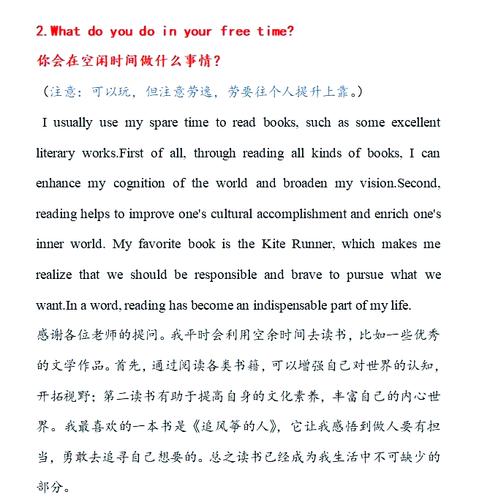
- What hobbies do you have in your spare time?
回答思路:
- 自我介绍:采用“基本信息+学术/实践亮点+未来规划”结构,时长控制在1-2分钟。“Good morning, professors. My name is [Name], a senior majoring in [Major] at [University]. During my undergraduate study, I focused on [research direction/course], participated in [project/competition], and published a paper about [topic]. Now I am applying for your [program] to deepen my knowledge in [field].”
- 优缺点:优点需结合专业需求(如“analytical ability”“teamwork”),缺点需说明改进措施(如“Sometimes I focus too much on details, but I’ve learned to prioritize tasks by using time management tools”)。
- 兴趣爱好:选择积极健康的活动,并关联个人特质(如“Reading helps me broaden horizons, especially academic books related to [field]”)。
学术背景与科研经历类问题
此类问题考察专业基础和学术潜力,需提前梳理本科课程、毕业设计、科研项目等细节。
常见问题:
- Why did you choose your undergraduate major?
- What is your graduation thesis about?
- Have you participated in any research projects? What was your role?
回答思路:
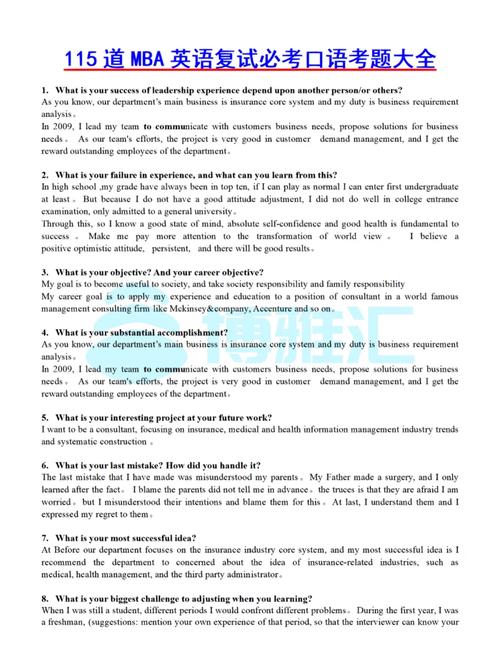
- 专业选择:结合兴趣、学科优势或未来目标,“I chose [Major] because of my passion for [related field], and the program’s emphasis on [practical theory] aligns with my career aspiration.”
- 毕业设计:清晰说明研究目的、方法、结论和成果,“My thesis explores [topic], using [method] to analyze [data]. The results show that [conclusion], which was published in [journal/presentation].”
- 科研经历:突出具体贡献(如“responsible for data collection”“designed the experiment”)和收获(如“learned to use [software/tool]”“improved problem-solving skills”)。
报考动机与未来规划类问题
核心是考察考生对目标院校、专业的了解程度及学习目标的明确性。
常见问题:
- Why do you want to pursue postgraduate study?
- Why did you choose our university/program?
- What are your career plans after graduation?
回答思路:
- 读研动机:避免泛泛而谈,需结合专业深度或行业需求,“To solve [specific problem in the field], I need advanced knowledge in [sub-discipline], which postgraduate study can provide.”
- 选择院校:提及导师研究方向、实验室资源或课程特色,“I admire Professor [Name]’s research on [topic], and your program’s collaboration with [industry/institution] offers practical opportunities.”
- 职业规划:分短期(毕业后1-3年,如“work as a [position] in [industry]”)和长期(5-10年,如“pursue a PhD or lead a research team”),体现逻辑性和可行性。
综合能力与应急类问题
这类问题考察临场反应和思辨能力,需保持冷静并展现积极态度。
常见问题:
- How do you handle pressure or failure?
- What qualities do you think a good researcher should have?
- Do you have any questions for us?
回答思路:

- 压力应对:举例说明具体经历(如“During a competition, our team faced technical issues, so I reorganized tasks and sought advice, which helped us overcome the difficulty”)。
- 研究者品质:结合学术场景,如“Persistence, critical thinking, and collaboration are key. For example, in my project, I discussed ideas with peers to refine my methodology.”
- 提问环节:准备1-2个有深度的问题,如“Could you introduce the research opportunities for postgraduates in your lab?”或“What are the key qualities you look for in a graduate student?”
回答注意事项
- 语言表达:发音清晰、语速适中,避免语法错误,可适当使用连接词(however, moreover)增强逻辑性。 准备**:提前梳理个人经历,结合目标专业调整重点,避免模板化回答。
- 仪态举止:保持微笑、眼神交流,展现自信和礼貌。
- 时间控制:问题回答时长一般1-2分钟,自我介绍不超过2分钟。
常见问题回答要点总结表
| 问题类型 | 核心考察点 | 回答关键点 |
|---|---|---|
| 个人基本情况 | 语言表达、个性特质 | 结构清晰,结合专业延伸 |
| 学术背景 | 专业基础、科研潜力 | 突出细节,量化成果 |
| 报考动机 | 目标明确性、院校了解度 | 具体化理由,提及导师/资源优势 |
| 综合能力 | 应变能力、思辨能力 | 举例说明,展现积极心态 |
相关问答FAQs
Q1: 如果被问到不会的问题,应该如何应对?
A1: 坦诚承认,并尝试关联已知知识。“I’m not familiar with this specific topic, but based on my understanding of [related concept], I think it might be related to [your guess]. I’d be happy to learn more about it.” 避免沉默或胡编乱造,态度诚恳即可挽回部分印象分。
Q2: 口试中紧张导致忘词或卡顿怎么办?
A2: 可短暂停顿,用“well”“you know”等填充词争取思考时间,或自然过渡到熟悉的内容。“That’s an interesting question. As far as I know, [related topic]...” 提前模拟练习,熟悉常见问题可减少紧张感,同时深呼吸调整心态,保持语速平稳。
考研复试英语口语的核心在于“有准备、有逻辑、有个性”,考生需结合自身经历打磨内容,通过反复练习提升流利度和应变能力,最终展现真实的学术潜力与综合素质。